Quick Answer: Most cybersecurity Board reports fail because they're too technical and don't drive decisions. Instead, boards need 3-10 pages per report delivered monthly or quarterly with 3-6 key metrics expressed in business language (dollars, risk appetite, ROI) rather than high/medium/low risk ratings. Reports should translate technical security into member protection, operational continuity, and regulatory compliance—the language boards actually understand and act on.
Why Board Reporting on Cybersecurity Matters
The board is ultimately responsible for the cybersecurity program—they can delegate execution, but accountability rolls uphill. Yet most boards don't understand what they're overseeing, which leads to three cascading problems:
- Lack of Understanding → Boards gloss over security content when overwhelmed
- Lack of Confidence → Without understanding, they can't make informed decisions
- Lack of Resources → Poor decisions mean security teams don't get the funding and support they need
Over 15+ years of creating hundreds of board reports for banks and credit unions, one pattern emerges: the most successful security programs have boards that actively ask questions, make informed decisions, and back those decisions with resources. This doesn't happen by accident—it happens through intentional, well-designed reporting.
A Board-Approved Cyber Risk Model
Start Quantifying Your Risk In Dollars Today


The #1 Problem: Too Much Technical Information
What Examiners See: Board reports crammed with CVEs, vulnerability counts, antivirus alerts, log ingestion percentages, and other technical jargon that boards don't understand.
What Happens: Board members tune out, skim the section, ask no questions, and move on. Silence on a decision request is a bad sign—it means they don't understand what you're asking.
The Fix: Translate everything into business impact.
What You're Reporting
|
What Boards Actually Care About |
"We blocked 10 million attacks"
|
"Our email filter prevented phishing that could have compromised member accounts" |
"99% of logs ingested into SIEM"
|
"We have continuous visibility to detect suspicious activity" |
"45 critical CVEs patched"
|
"We reduced critical vulnerabilities by 80%, lowering risk of operational disruption" |
"EDR deployed on 500 endpoints"
|
"We can detect and respond to threats faster, protecting members and operations" |
Your Action Items:
- Remove CVE counts, vulnerability numbers, and technical metrics
- Replace with business impact language: member protection, operational continuity, regulatory compliance
- Use dollar amounts, percentages, and timeframes (not technical jargon)
- Connect each initiative to a business outcome boards care about
Step 1: Know Your Audience
Your board likely includes a farmer, a hospital administrator, a medical doctor, a C-level executive from an insurance company, or a small business owner. None of them are cybersecurity experts. Many aren't technical at all.
What This Means:
- Don't assume technical knowledge
- Use language they use in other parts of the board meeting (financial metrics, ROI, risk appetite)
- Connect security to member experience, operational resilience, and regulatory compliance
- Frame decisions in terms of business strategy and goals
Your Action Items:
- Research board member backgrounds (LinkedIn, company bios)
- Understand their expertise and perspective
- Note which board members ask questions on other topics
- Tailor depth/detail to board composition
Step 2: Determine What to Report
Board meetings have three core purposes:
- Status Updates – What's the current state of the security program?
- Strategic Initiatives – What efforts are underway to reduce risk?
- Decisions Needed – What approvals or commitments are required?
Your report should address all three without overwhelming the board.
Structure:
- Status Section (1 page) – Key metrics showing program health
- Initiatives Section (1-2 pages) – What's being done to reduce risk
- Decision Items (1 page) – What you're asking the board to approve
- Technical Appendix (optional) – Details for auditors/examiners
Key Question: If I ask for a decision and get no questions, what does that mean?
Answer: It means they don't understand what I'm asking. Silence on a decision request is rarely a good sign.
Step 3: Get the Length Right (3-10 Pages Is the Sweet Spot)
What We See:
- Too Long (50+ pages): Nobody reads them. They end up as evidence files, not decision-making tools.
- Too Short (1 page): Not enough context for meaningful decisions, though some boards request this.
- Goldilocks Zone (3-10 pages): Enough information for solid decision-making without overwhelming busy board members.
Length By Report Type:
Report Type
|
Frequency |
Length |
Contents |
Monthly Status
|
Monthly |
1-2 pages |
Key metrics, summary of initiatives, upcoming decisions |
Quarterly Deep Dive
|
Quarterly |
5-8 pages |
Full program status, control maturity, risk trends, decisions needed |
Annual Comprehensive
|
Annually |
8-10 pages |
Includes technical details for examiners, full year trends, strategic roadmap |
Your Action Items:
- Establish target page length for your reporting cadence
- Include only information boards need to make decisions
- Move technical details to appendix (for auditors, not board)
- Use visuals (dashboards, charts) to reduce word count while increasing clarity
Step 4: Report Frequency Matters
Ideal: Monthly or at least quarterly
Why: Consistency builds understanding. If boards see the same metrics and dashboard format repeatedly, they internalize what healthy looks like. Changing format quarterly confuses them.
What We See Work Well:
- Monthly reports: 1-2 page executive summary with key metrics (same format every month)
- Quarterly reports: 5-8 page deep dive with additional detail and analysis
- Annual reports: Comprehensive review with technical appendix for examiners
Your Action Items:
- Establish consistent reporting cadence (push for at least quarterly minimum)
- Use same format/layout every report (dashboard analogy: your car's dashboard is the same every time you drive)
- Monthly consistency builds understanding that a one-time annual report cannot achieve
- If budget/resources limited, do monthly one-pagers with quarterly deep dives
Key Insight: Consistency matters more than length. A one-page report delivered monthly beats a 10-page report delivered once a year.
Step 5: The 3-6 Core Metrics Framework
Forget hundreds of metrics. Focus on 3-6 that actually drive board decisions.
Metric 1: Top Cyber Risk (in Dollars)
What to Show: Bar chart with top 5 cybersecurity risk scenarios expressed in dollar exposure.
Example:
Top Cyber Risks by Dollar Exposure
Ransomware - Core System: $4.2M (highest impact if occurs)
Unauthorized Data Access: $2.1M (member data breach)
Payment System Disruption: $1.8M (inability to process transactions)
Vendor Breach (Payment Proc.): $1.5M
Third-Party Incident: $0.9M
Why Boards Care: Everyone understands dollars. It answers: "What could hurt us most?"
Your Action Items:
- Quantify top 5 risks in financial terms
- Update quarterly as risk profile changes
- Explain methodology once, reference it going forward
- Highlight if any risks exceeded risk appetite (see metric 2)
Metric 2: Risk vs. Risk Appetite
What to Show: Simple visual comparing measured risk to board-approved risk appetite.
Example:
Risk Status vs. Board Appetite
Total Cyber Risk: $12.3MRisk Appetite: $15.0M (board-approved)Status: Within appetiteTrend: Down from $13.8M last quarter
Why Boards Care: The board sets the "line in the sand" (risk appetite). When risk crosses it, action is required. This is a management dashboard.
Your Action Items:
- Establish and document board-approved risk appetite
- Measure actual risk using same methodology
- Report quarterly (or monthly if rapid changes)
- Trigger decisions when risk exceeds appetite
- Show progress toward reducing risk
Metric 3: Risk Trend Over Time
What to Show: Line chart showing risk trajectory (ideally declining) over 12 months.
Why Boards Care: Trends show whether your program is actually improving or just treading water.
Example:
12-Month Risk Trend
Month 1: $15.2M
Month 2: $15.0M
Month 3: $14.8M
Month 4: $14.5M
Month 5: $14.2M
Month 6: $13.9M
Month 7: $13.6M
Month 8: $13.3M
Month 9: $13.0M
Month 10: $12.7M
Month 11: $12.5M
Month 12: $12.3M
Trend: Declining (good)
Your Action Items:
- Track quarterly risk measurements for 12-month view
- Show initiatives completed and their risk reduction
- Update monthly/quarterly consistently
- Use as validation that recommendations are working
Metric 4: Control Maturity (Not Compliance)
What to Show: Maturity level (1-5 scale) for key controls across quarters.
Why Not Compliance: Compliance is binary (yes/no). Maturity shows how well controls are implemented and
improving.
Example:
Key Control Maturity Trend
Control Q1 Q2 Q3 Q4 Target
MFA Implementation 2.1 2.3 2.5 3.0
Vulnerability Mgmt 2.0 2.2 2.4 2.8
Incident Response 2.3 2.4 2.5 3.0
Risk Assessment 2.2 2.4 2.6 3.0
Your Action Items:
- Select 4-5 critical controls for reporting
- Define maturity scale (foundational, developed, optimized)
- Track quarterly improvements
- Connect improvements to risk reduction
Metric 5: Board-Approved Roadmap with Quantified Risk Reduction
What to Show: 1-2 page visual roadmap of planned initiatives with dollar impact.
Example:
2024 Cyber Security Roadmap
Q1: Implement MFA | Cost: $50K | Risk Reduction: $800K | ROI: 1,600%
Q2: Advanced Threat Detection | Cost: $150K | Risk Reduction: $1.2M | ROI: 800%
Q3: Vendor Risk Program Overhaul | Cost: $80K | Risk Reduction: $600K | ROI: 750%
Q4: Incident Response Enhancement | Cost: $40K | Risk Reduction: $500K | ROI: 1,250%
Why Boards Care: This is decision-making material. Each initiative has clear cost, benefit, and ROI. Boards can prioritize based on appetite and budget.
Your Action Items:
- Develop 3-5 year roadmap with quantified initiatives
- Update quarterly based on execution and changing risk
- Calculate ROI for each initiative (gain/cost × 100)
- Frame as trade-offs: "If we do initiatives X and Y, risk drops to $10M. If we add Z, risk drops to $8M but costs more"
Metric 6 (Optional): Compliance Status
What to Show: Simple checklist showing NCUA/FDIC/Examiner requirements met.
Why Boards Care: Regulatory risk is material. A simple checklist shows status.
Example:
Regulatory Compliance Status
-Annual Risk Assessment: Current (Met)
-Board Training: Completed Q1 (Met)
-Third-Party Reviews: 80% complete, due Q3 (In Progress)
-Incident Response Testing: Completed Q2 (Met)
The Biggest Mistake: High/Medium/Low Risk Ratings
Why They Fail:
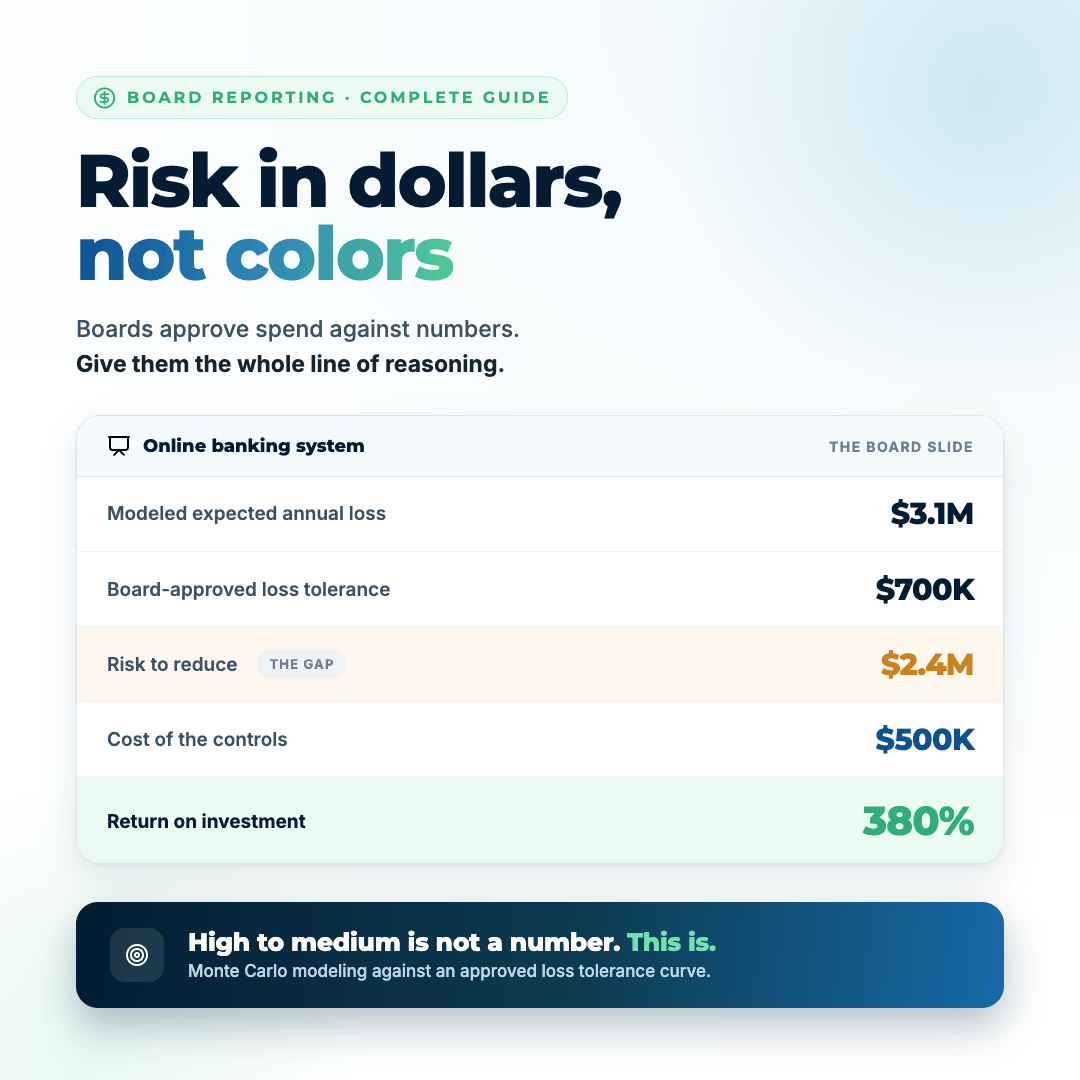
High/medium/low is subjective. "Medium" risk to one person is "high" to another. Plus, it doesn't drive decisions.
Board Thinking: "We're at medium? Okay, we're fine." (No decision made.)
vs. Quantified Thinking: "We're at $12.3M risk, appetite is $15M?" (Questions follow.)
The Fix: Move to financial quantification.
Old Approach
|
New Approach |
Outcome |
"Cyber risk is medium"
|
"Cyber risk is $12.3M, appetite is $15M" |
Board engages, asks questions |
"98% of patches applied"
|
"Critical vulnerabilities reduced 80%, down from 5 to 1" |
Board sees progress |
"3 incidents this quarter"
|
"$850K potential loss prevented by incident response" |
Board values the program |
Your Action Items:
- Stop using high/medium/low for risk
- Replace with dollar-based quantification
- Include board-approved appetite for context
- Show trend and explain drivers
How to Get Buy-In When Your Board Resists Change
Common Pushback: "We don't want financial risk numbers. How do we know they're accurate?"
The Answer: Training.
What Works:
- Schedule a dedicated board training (30-45 minutes ideally)
- Walk through the methodology – Explain where numbers come from, how they're calculated
- Show the data sources – Breach statistics, industry benchmarks, your own assessment methodology
- Answer the confidence question – "How do we know we can trust these numbers?"
- Present the new format – "Here's what your monthly report will look like going forward"
Result: Boards that have gone through training rarely push back. They understand the "why" and see the value.
Your Action Items:
- Schedule one training per year minimum
- Include both board members and audit committee
- Use external validation (industry data, consultant perspective) to build credibility
- Frame as "improving board decision-making," not "changing compliance"
Common Mistakes & How to Fix Them
Mistake 1: Vanity Metrics
What It Looks Like: "We blocked 10 million attacks" or "99% of logs ingested"
Why It Fails: Boards don't understand what those numbers mean or why they matter.
Fix: Translate to business impact. "Our email filter and threat detection prevented phishing that could have compromised 2,000+ member accounts."
Mistake 2: Static One-Off Slide Decks
What It Looks Like: Different report format every quarter; metrics change every time.
Why It Fails: Boards can't track trends or understand what "normal" looks like.
Fix: Same format, same metrics, every report. Let trends speak for themselves.
Mistake 3: No Clear Decisions Needed
What It Looks Like: Report is all status, no asks.
Why It Fails: Boards aren't engaged; they're just receiving information.
Fix: Every report should have 1-2 clear decision items. "We recommend approving $150K investment in advanced threat detection. Expected risk reduction: $1.2M."
Mistake 4: Mixing Auditor Requirements with Board Needs
What It Looks Like: One report trying to satisfy both examiners and board (50+ pages, heavy technical detail).
Why It Fails: Boards are overwhelmed; examiners miss key governance items.
Fix: Executive summary for the board (3-8 pages, business language). Technical appendix for examiners (separate document).
Handling Examiner Requirements While Keeping Boards Engaged
The Tension: Examiners want technical details. Boards need business language.
The Solution: Two-Part Report Structure
Part 1: Board Report (Pages 1-3)
- Status in business language
- Key metrics and decisions
- What the board needs to know
Part 2: Technical Details (Pages 4-10)
- Labeled "Additional Details for Auditor/Examiner Review"
- CVEs, vulnerability counts, technical metrics
- Compliance checklists
- Testing evidence
Result: Board sees what they need (above the fold). Examiners get documentation they require (in appendix).
Framing Cybersecurity as Investment, Not Cost
How Boards Think: Everything else in the organization is presented as ROI and business impact.
What Fails: "We need $150K for a security tool." (No context, no ROI.)
What Works: "We're experiencing 2-3 phishing incidents per month costing $50K each in remediation. A
$150K email security investment reduces those to 2-3 per year. Payback in one year, ongoing savings $75K annually."
Your Action Items:
- Quantify cost of incidents (incident response, member notification, regulatory fines)
- Calculate ROI for each initiative (risk reduction $ ÷ cost × 100)
- Compare against other organizational investments for context
- Frame as business decision, not security decree
Example ROI Calculation:
Initiative: Advanced Threat DetectionCost: $150,000Expected Risk Reduction: $1,200,000ROI: ($1,200,000 ÷ $150,000) × 100 = 800%
This compares extremely favorably to other organizational investmentstypically seen at 15-25% ROI.
Key Takeaways: Board Reporting That Works
- Know your audience – Board members are business people, not security experts
- Keep it concise – 3-10 pages; monthly or quarterly; consistent format
- Translate to business language – Dollars, ROI, member protection, operational continuity
- Use 3-6 core metrics – Risk in dollars, risk vs. appetite, trends, maturity, roadmap, compliance
- Eliminate technical jargon – No CVEs, vulnerability counts, or antivirus alerts
- Drive decisions – Every report should ask for something; silence means confusion
- Train the board – Help them understand the "why" behind new formats
- Show trends – Same metrics every report so boards see progress
- Separate board reporting from auditor documentation – Different audiences need different information
- Frame as ROI, not cost – Security is an investment with measurable business impact
Final Takeaway
The best cybersecurity board reports don't try to make boards into security experts. Instead, they translate security into the language boards already understand: business impact, risk management, and return on investment.
When boards understand the program, ask tough questions, and make informed decisions, cybersecurity teams get the resources, support, and alignment they need to actually reduce risk. That's when security programs mature from cost centers to strategic assets.
A Board-Approved Cyber Risk Assessment
Start Quantifying Your Risk In Dollars Today


 Lucas Hathaway
 Randy Lindberg : 19 Aug 2026


 Lucas Hathaway