For CISOs, risk leaders, compliance teams, and internal audit stakeholders at financial institutions, an AI inventory is quickly becoming a practical governance requirement rather than a nice-to-have. As banks, credit unions, and fintech-adjacent teams adopt AI across workflows, vendor tools, customer service, fraud operations, and internal productivity, leadership needs a reliable way to identify where AI is used, who owns it, what data it touches, and what controls apply. This guide explains what an AI inventory is, why it matters in financial services, what fields to include, and how to build one that supports governance, risk management, and exam readiness.
Key takeaways from this article:
- An AI inventory is the operational foundation for AI governance, risk assessment, and oversight.
- The NIST AI RMF’s Govern 1.6 explicitly calls for mechanisms to inventory AI systems, resourced according to organizational risk priorities.
- A strong inventory helps institutions support vendor due diligence, policy enforcement, control mapping, and board/exam reporting.
- Schedule a demo to see how Rivial Security can help centralize AI governance, evidence, and risk tracking.
Free AI Information Security Policy
Kickstart your AI policy with our template, built on the latest best practices


What is an AI Inventory?
An AI inventory is a centralized record of the artificial intelligence systems, tools, models, and AI-enabled vendors your institution uses or relies on. In practice, it is less about creating a static spreadsheet and more about establishing a governed system of record: what AI exists, where it is used, who is accountable for it, what risks it introduces, and what controls are in place. That aligns directly with NIST’s AI RMF Govern 1.6, which calls for mechanisms to inventory AI systems and resource them according to organizational risk priorities.
For financial institutions, the scope should usually go beyond internally built models. It should also include third-party software with embedded AI, generative AI tools used by employees, vendor models that influence operations or customer outcomes, and high-impact use cases that may affect security, compliance, privacy, fraud, or consumer risk. NCUA’s current AI resources emphasize governance, security, privacy, and controls for AI use cases, and the banking agencies’ third-party risk guidance reinforces that outsourced technology does not remove the institution’s oversight obligations.
Why AI Inventories Matter More in Financial Services
Financial institutions operate in an environment where governance gaps become executive issues quickly. An undocumented AI use case can create uncertainty around data handling, vendor oversight, model accountability, explainability, and control ownership. That is exactly why an AI inventory matters: it gives security, risk, compliance, and audit teams a single starting point for asking the right questions before AI adoption expands faster than oversight.
This is especially important because many institutions are not only evaluating AI built in-house. They are also consuming AI through third parties, including software platforms, fraud tools, productivity tools, analytics products, and customer-facing systems. OCC, the FDIC, and the Board’s interagency guidance on third-party risk management makes clear that institutions are expected to apply risk management across the full life cycle of third-party relationships. If a vendor’s product uses AI in a material way, the institution still needs a defensible understanding of how that technology fits into its control environment.
A mature AI inventory also makes executive communication easier. Instead of trying to answer ad hoc questions about “where we use AI,” leadership can report on AI use cases by business unit, risk tier, vendor dependency, data sensitivity, or control maturity. That moves AI oversight out of the abstract and into a form the board, audit committee, examiners, and senior management can actually work with.
What to Include in an AI Inventory Template
A useful AI inventory should be practical enough for business teams to complete and structured enough for governance, risk, and audit functions to rely on.
1. System or use case name
Start with the plain-language name of the AI system, tool, model, or use case. If the institution uses a vendor platform with embedded AI, record both the platform name and the specific AI-enabled capability in scope.
2. Business owner
Every AI entry should have a clearly accountable business owner. That owner should be responsible for validating the use case, participating in reviews, and coordinating remediation when needed.
3. Technical or security owner
Business ownership alone is not enough. There should also be a technical, security, or risk point of contact who can speak to architecture, controls, integrations, and monitoring.
4. Vendor or internal build
Indicate whether the AI capability is:
- internally developed
- embedded in a third-party platform
- provided by a model vendor or API
- introduced through an employee productivity or workflow tool
This distinction matters because oversight expectations differ, but responsibility does not disappear when the AI capability comes from a third party.
5. Business purpose
Document what the AI system is used for. Examples:
- fraud detection
- underwriting support
- customer service assistance
- internal knowledge search
- document classification
- marketing content generation
- cybersecurity alert triage
This field is essential because governance decisions should be tied to actual institutional purpose, not just technical labels. NIST’s AI RMF emphasizes context as a core part of risk management.
6. Data inputs and sensitivity
Record what data the system uses and whether that data includes:
- customer information
- nonpublic personal information
- employee data
- financial data
- confidential business information
- regulated data
- public or synthetic data only
For financial institutions, this is one of the most important fields in the inventory because it shapes privacy, security, and compliance obligations.
7. Outputs and decisions influenced
Document what the AI system produces and whether those outputs influence or support:
- customer-facing decisions
- fraud reviews
- case prioritization
- policy enforcement
- internal reporting
- employee productivity
- risk scoring
This helps distinguish low-impact AI from high-impact AI that may require deeper review and stronger controls. NCUA’s AI compliance plan specifically notes that higher-impact AI use cases may require augmented procedures.
8. Risk tier or inherent risk rating
Assign a risk level such as low, moderate, high, or critical. Common rating factors include:
- sensitivity of data used
- level of human oversight
- customer or member impact
- regulatory exposure
- security implications
- reliance on third-party vendors
- potential for bias, drift, or incorrect outputs
Free AI Information Security Policy
Kickstart your AI policy with our template, built on the latest best practices
9. Human oversight and approvals
Record whether human review is required before action is taken, who performs that review, and where escalation occurs. In financial services, oversight and accountability matter just as much as model capability.
10. Control requirements
Your inventory should tie each AI system to key governance and security controls, such as:
- approved use case documentation
- vendor due diligence completed
- security review completed
- privacy review completed
- AI policy acknowledgment
- monitoring in place
- incident response playbook assigned
- periodic reassessment scheduled
This is where the inventory becomes more than an asset list. It becomes a control-mapping and governance tool.
11. Evidence location
Document where supporting evidence lives:
- risk assessment
- vendor review
- contract terms
- policy exception
- testing results
- monitoring logs
- committee approvals
- audit artifacts
If evidence is scattered, the inventory becomes much harder to trust.
12. Review date and status
Include a required review cycle and current status:
- proposed
- approved
- active
- restricted
- retired
That makes it easier to manage change over time instead of treating the inventory as a one-time intake exercise.
How to Build an AI Inventory That Actually Works
1. Start with discovery, not perfection
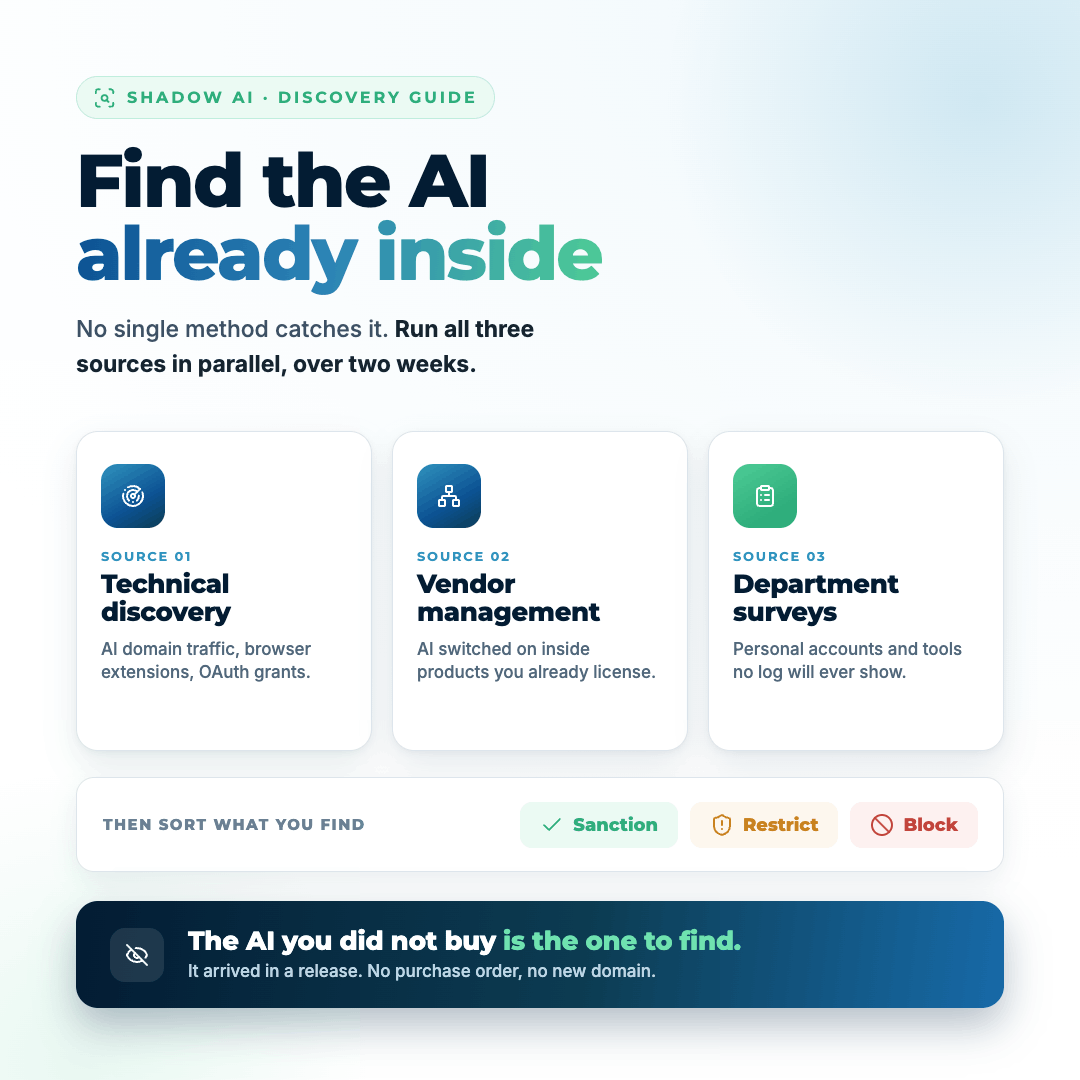
Most institutions already have more AI exposure than they think. Start by identifying obvious sources:
- approved software stack
- vendor inventory
- procurement records
- security questionnaires
- business unit interviews
- employee-submitted tools
- known internal automations or models
The goal of the first pass is coverage, not elegance.
2. Include AI-enabled vendors, not just “AI projects”
This is where many inventories fail. Teams focus only on internal AI initiatives and miss third-party platforms with embedded AI features. But if your institution uses a vendor whose product relies on AI for analysis, automation, recommendations, or decision support, that still belongs in your governance picture. Third-party risk guidance from the banking agencies makes this especially important.
3. Tie the inventory to your AI policy and review workflow
An inventory becomes much more useful when new AI use cases cannot move forward without being added to it. That means connecting the inventory to:
- procurement reviews
- security reviews
- change management
- legal/privacy review
- model or use-case approval processes
This also aligns with the governance-oriented approach reflected in NIST’s AI RMF and current NCUA AI compliance materials.
4. Use risk tiers to prioritize depth of review
Not every AI use case needs the same governance burden. A low-risk internal drafting assistant should not necessarily go through the same review path as an AI system influencing fraud decisions or handling sensitive member data. Risk-tiering lets institutions apply proportionate governance without losing control.
5. Treat the inventory as a living system of record
AI tools change quickly. Vendors release new features, business teams experiment with new use cases, and risk profiles shift as data or outputs change. The inventory should therefore have periodic review triggers and ownership, not just a one-time launch date.
Common Mistakes That Weaken AI Inventories
Treating the inventory like a spreadsheet exercise
If the inventory exists only to satisfy a governance checkbox, it will drift out of date quickly. The stronger model is to connect it to real reviews, approvals, and evidence.
Capturing only internal models
For many financial institutions, the larger near-term exposure is third-party and embedded AI, not custom-built models. Missing those systems creates a false sense of completeness.
Skipping ownership
If no one owns the AI use case, no one owns updates, evidence, or remediation. Every entry needs accountable ownership.
Ignoring data sensitivity
A list of AI tools without data context is not very useful. Financial institutions need to know what information is being used, exposed, or processed.
Not linking the inventory to controls
An AI inventory should help answer governance questions, not create new ones. If the inventory does not show required controls, review status, and evidence, it will not support audit, exam, or board conversations effectively.
Get Started with Rivial Security Today
For CISOs and risk leaders at financial institutions, an AI inventory is valuable because it creates visibility before AI adoption outpaces governance. A strong inventory helps institutions identify where AI is used, who owns it, what risks it introduces, what controls apply, and where evidence lives when audit, exam, or board questions come up. NIST’s AI risk management framework supports this approach, and current regulator materials show the direction of travel clearly: AI use should be documented, governed, and aligned with broader security, privacy, and risk management processes.
If your team is still trying to track AI tools, vendor usage, risk reviews, and governance evidence across spreadsheets, shared drives, and email threads, there is a better way forward. Schedule a demo to see how Rivial Security can help centralize AI governance, streamline oversight, and support a more audit-ready approach to AI risk management.
Free AI Information Security Policy
Kickstart your AI policy with our template, built on the latest best practices


 Lucas Hathaway

 Lucas Hathaway : 12 Aug 2026


 Randy Lindberg