

 Lucas Hathaway
1 min read
How to Write a Cyber Risk Appetite Statement
 Lucas Hathaway : 20 Aug 2026
For CISOs, IT risk leaders, compliance officers, and the board committees they report to, a cyber risk appetite statement is the document that...

For CISOs, IT risk leaders, compliance teams, and privacy and audit stakeholders, an AI acceptable use policy is fast becoming the line between governed AI adoption and ungoverned shadow AI. As employees reach for generative AI to draft documents, summarize data, write code, and answer customer questions, leadership needs a clear, enforceable statement of what is allowed, what is prohibited, which data may be used, and where human review is required. Without one, sensitive information can flow into third-party models, decisions can be made on unverified output, and examiners and auditors are left with no evidence that AI use is controlled. This guide explains what an AI acceptable use policy is, why it matters more in regulated industries, what to include, and how to roll one out that holds up under audit, exam, and board scrutiny.
Key takeaways from this article:
Automate your vendor due diligence and SOC report reviews.


An AI acceptable use policy (AI AUP) is a formal document that defines how employees, contractors, and third parties may and may not use artificial intelligence tools — especially generative AI — on behalf of the organization. It establishes approved tools and use cases, classifies what data may be entered into AI systems, sets requirements for human review of AI output, and assigns accountability for oversight and enforcement.
Think of the policy as the workforce-facing layer of a broader AI governance program. Where an AI inventory answers “where is AI used and who owns it,” and a risk assessment answers “how much risk does each use case carry,” the acceptable use policy answers the day-to-day question every employee actually faces: “Can I paste this into that tool, and what do I do with the answer?” It translates governance intent into rules people can follow. This aligns directly with the NIST AI Risk Management Framework, whose Govern function calls for documented policies, clear accountability, and oversight mechanisms for AI use.
A useful AI AUP is short enough that employees will read it and specific enough that it actually changes behavior. It is not a research paper on AI ethics, and it is not a one-line ban. It is a practical rulebook that names the approved tools, draws bright lines around sensitive data, and makes clear who is accountable when something goes wrong.
In regulated environments, governance gaps become executive issues quickly. The most pressing AI risk for most organizations today is not a rogue in-house model — it is shadow AI: employees pasting customer records, financial data, source code, or protected health information into consumer AI tools that were never reviewed, contracted, or secured. Once that data leaves your control, you typically cannot pull it back, and you may have created a privacy or confidentiality exposure you cannot fully measure.
Regulators have made clear that outsourcing technology does not outsource responsibility. NCUA’s AI resources emphasize governance, security, privacy, and controls for AI use cases, and the banking agencies’ interagency third-party risk management guidance reinforces that institutions remain accountable for risks introduced by vendor technology, including embedded AI. The same expectation shows up across other regulated sectors: healthcare teams must protect PHI under HIPAA, higher education must protect student records under FERPA, and any organization handling nonpublic personal information has to be able to show where that data goes. An acceptable use policy is the document that demonstrates the organization set rules, communicated them, and can enforce them.
A clear policy also makes executive communication easier. Instead of fielding ad hoc questions about “what are we letting people do with AI,” leadership can point to an approved-tool list, a data-handling standard, and acknowledgment records. That moves AI oversight out of the abstract and into a form the board, audit committee, examiners, and senior management can actually work with.
A strong AI acceptable use policy should be practical enough for every employee to follow and structured enough for governance, security, and audit functions to rely on. The sections below form a reusable template.
State why the policy exists and who it covers. Most policies apply to all employees, contractors, and third parties using AI on the organization’s behalf, and cover both standalone AI tools and AI features embedded in approved software.
Define artificial intelligence, generative AI, machine learning, and “AI tool,” with concrete examples. Shared definitions keep the policy from being argued around later.
List the AI tools that are approved, conditionally approved, or prohibited. Tiering works better than a blanket ban because it gives employees a sanctioned path instead of pushing them toward unmonitored tools.
Spell out what is never permitted — for example, entering nonpublic personal information, PHI, credentials, or confidential business data into unapproved tools, or using AI output as the sole basis for consequential decisions.
Tie the policy to your data classification scheme. State exactly which data types may be used with which tier of tool, and require that regulated or confidential data only be used in approved, contractually covered environments.
Require a human in the loop wherever AI output influences a decision, a customer interaction, or a published work product. Make clear that the employee, not the model, is accountable for the result.
Address how AI use intersects with privacy obligations, confidentiality agreements, and ownership of inputs and outputs, including the risk of exposing proprietary information through prompts.
For use cases that affect customers, members, patients, students, or employees, require additional review for bias, accuracy, and explainability before AI influences the outcome.
Reference authentication, access control, logging, and approved-configuration requirements for AI tools, and prohibit connecting unapproved AI services to internal systems or data stores.
Name the owner of the policy, the committee or function responsible for AI oversight, and the process for approving new tools or granting exceptions.
Describe how compliance is monitored, how violations are handled, and how the policy connects to existing disciplinary and incident processes.
Require formal acknowledgment from each employee and set a review cadence so the policy keeps pace with new tools, new use cases, and new regulatory guidance.
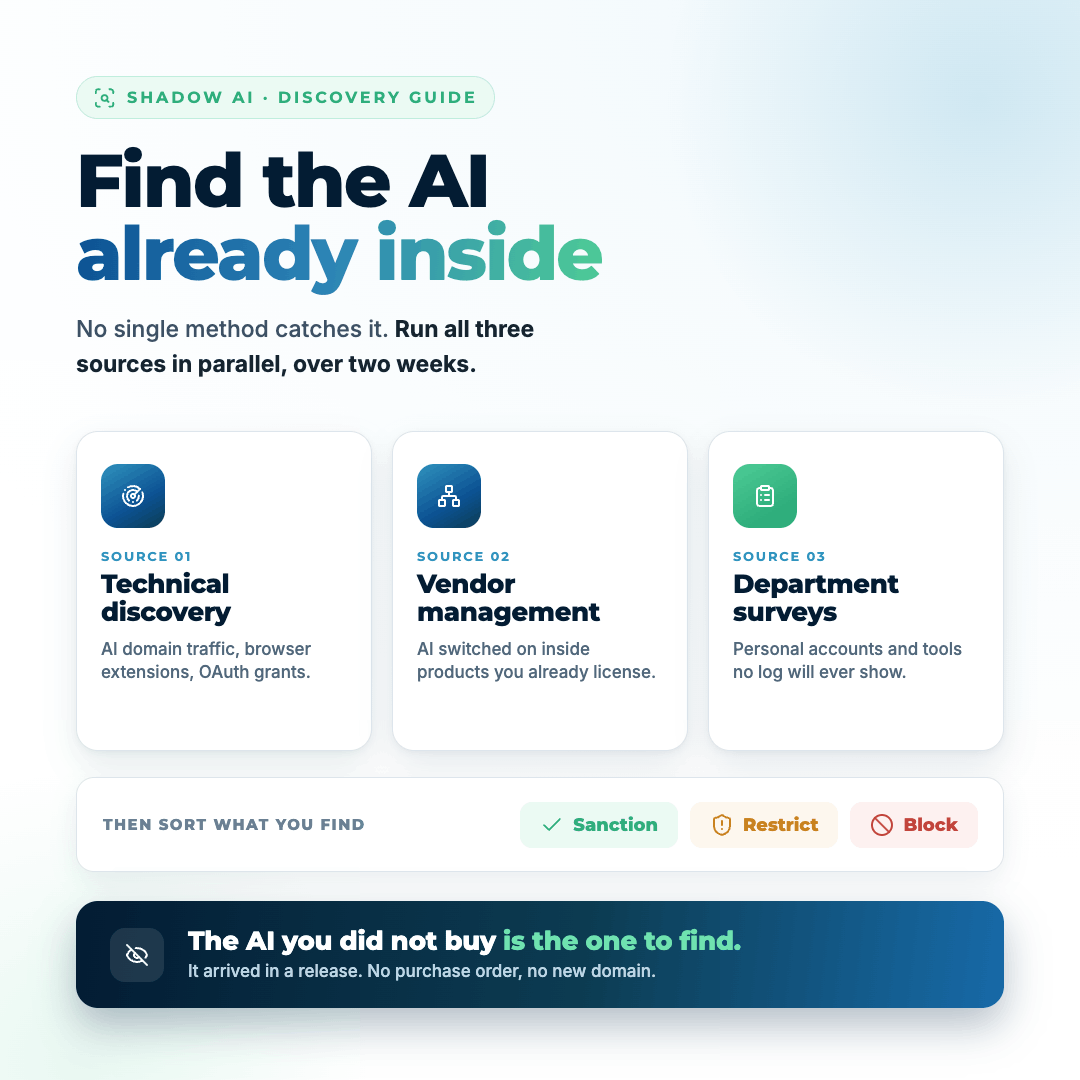
Most organizations already have more AI use than they realize. Survey business units, review expense and procurement records, and check approved software for embedded AI features. You cannot write realistic rules until you know how people are actually using AI today.
Map the policy to the NIST AI RMF, particularly its Govern function, so it is defensible and aligned with where regulators are heading. Anchoring to an external standard also makes the policy easier to explain to the board and examiners.
A prohibition that ignores how people work simply drives AI underground. Approving a vetted, contractually covered tool for sanctioned use cases gives employees a safe path and sharply reduces shadow AI.
Distributing a policy by email is not the same as governance. Pair the policy with brief training and a formal acknowledgment so you can show that each person received, understood, and agreed to the rules.
New AI tools and AI-enabled vendors should not enter the environment without review. Wiring the policy into procurement, vendor due diligence, and your AI inventory keeps the rulebook and the real environment in sync.
AI capabilities change fast. Assign an owner and a review trigger so the approved-tool list, data rules, and definitions stay current rather than drifting out of date.
An outright prohibition feels safe on paper but pushes employees toward personal accounts and unmonitored tools. A tiered, approved-use model governs behavior far more effectively.
“Don’t share sensitive information” is not enforceable. Tie the policy to specific data classifications and name exactly what may and may not be entered into each tier of tool.
If no one owns the policy, no one maintains the approved-tool list, reviews exceptions, or acts on violations. Every policy needs an accountable owner and a clear enforcement route.
A policy written once and never revisited becomes inaccurate the moment a major new tool appears. Build in a review cadence and ownership from the start.
Much of the near-term exposure comes from AI baked into vendor products, not tools employees install themselves. A policy that addresses only standalone apps misses a large part of the risk, which is why it should connect to your vendor risk and AI governance processes.
For security and risk leaders in regulated industries, an AI acceptable use policy is valuable because it sets guardrails before AI adoption outpaces oversight. A strong policy helps organizations define which tools are approved, protect the data that matters most, require human review of AI output, and document the control evidence that audit, exam, and board questions inevitably demand. The NIST AI Risk Management Framework supports this approach, and current regulator materials point the same direction: AI use should be documented, governed, and aligned with broader security, privacy, and risk management processes.
If your team is still trying to manage AI tools, employee usage, and policy exceptions across spreadsheets, shared drives, and email threads, there is a better way forward. Schedule a demo to see how Rivial Security can help build and operationalize your AI governance program, connect your policy to an AI inventory and review workflow, and support a more audit-ready approach to AI risk management.
Automate your vendor due diligence and SOC report reviews.

1 min read
Lucas Hathaway : 20 Aug 2026
For CISOs, IT risk leaders, compliance officers, and the board committees they report to, a cyber risk appetite statement is the document that...
1 min read
Lucas Hathaway : 12 Aug 2026
A security officer at a credit union described their AI inventory to us like this: they went through the exercise, came out the other side with only...

1 min read
Lucas Hathaway : 24 Jul 2026
For CISOs, IT risk leaders, compliance officers, and vCISOs, a cybersecurity risk register is the single source of truth that turns scattered...