Quick answer: A qualitative cyber risk assessment rates risk with labels like high, medium, and low, often on a color-coded heat map. A quantitative cyber risk assessment expresses risk in numbers, usually dollars and probabilities. Qualitative is fast and good for a first pass. Quantitative is what lets you prioritize spending and report to a board, because it shows magnitude, not just rank. The strongest programs use qualitative scoring to triage, then quantify the risks that matter in dollars. If your assessment ends at a color, it is qualitative, and it is leaving the most useful decision on the table.
Most regulated organizations run a qualitative assessment because it is what the template gave them. It produces a tidy heat map, it satisfies the binder, and it stops there. The question worth asking is whether that color rating is actually helping you decide anything. If you lead security at a credit union, bank, or similar organization, the difference between these two approaches is the difference between a report you file and a report you can budget against.
This guide compares the two approaches, shows the strengths and limits of each, walks through an example, and explains when to move from one to the other.
An Examiner Approved Cyber Risk Model
Check out the Cyber Risk Management Model that examiners reference below


What is a qualitative cyber risk assessment?
A qualitative assessment scores each risk on likelihood and impact using ordinal labels: high, medium, low, or a one-to-five scale. The result is the familiar red, yellow, and green heat map.
Its strengths are real. It is fast, it needs no special data, and it is good enough to triage a long list of risks quickly. For a first look, or for a small organization just standing up a risk program, it works and it is a reasonable place to begin.
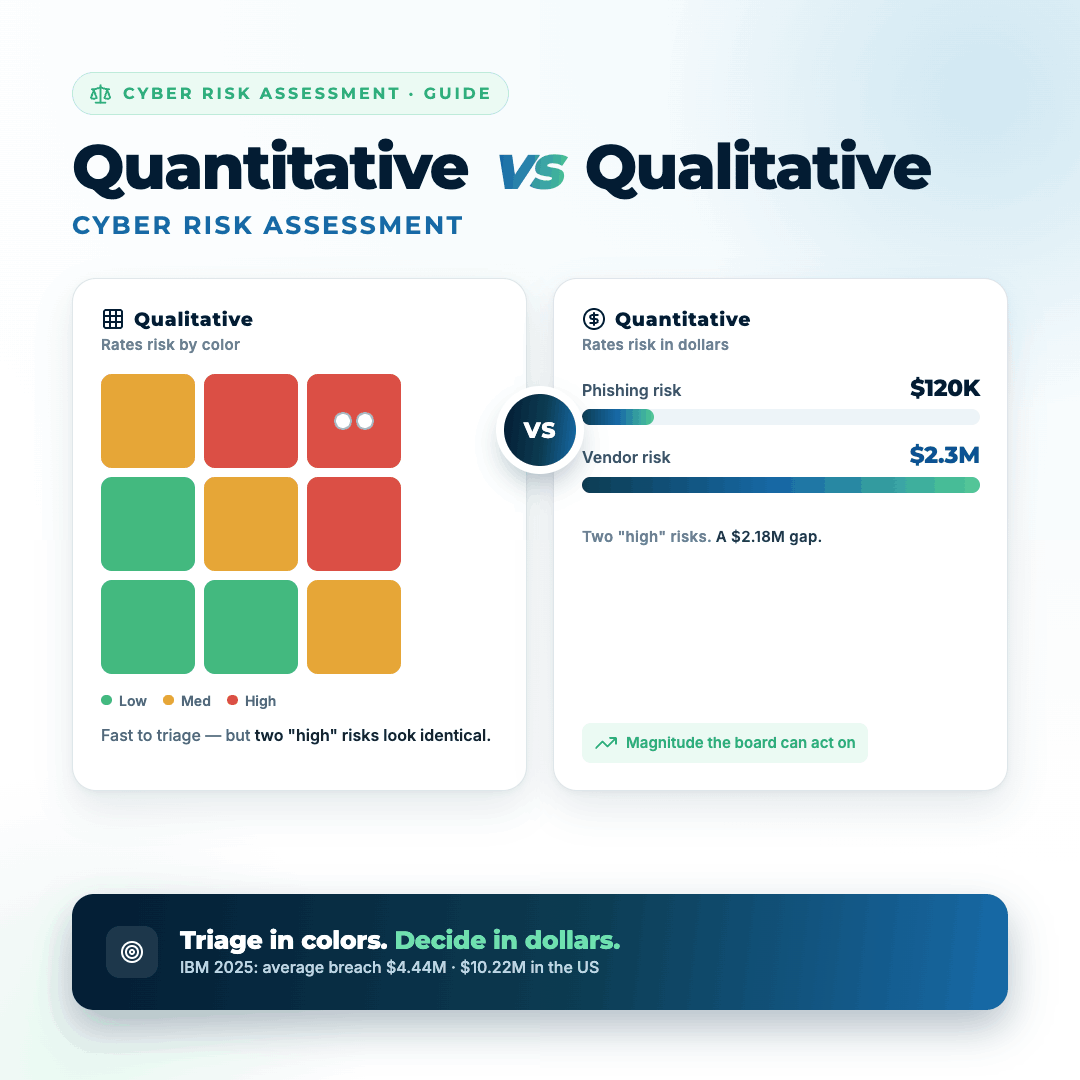
Its limit is that it hides magnitude. Two risks can both land on "high" while one threatens $50,000 and the other threatens $5 million. On the heat map they are the same square. That flatness is why qualitative ratings cannot tell you where to spend: everything urgent looks equally urgent, and the scores are also subjective, so one assessor's "high" is another's "medium."
What is a quantitative cyber risk assessment?
A quantitative assessment puts numbers on the same risks: how much a loss would cost and how likely it is over a period. The output is a dollar figure, ideally a range with probabilities attached. The structure usually comes from a model like FAIR, with Monte Carlo simulation handling the uncertainty, covered in our guide to cyber risk quantification models.
Its strength is that it shows magnitude and supports decisions. When a risk is "$5 million in potential loss" and a control that reduces it costs $150,000, the priority is obvious and the tradeoff is something a board can vote on. Quantitative results speak the language leadership already uses for every other risk.
Its cost is effort and data. You have to estimate frequency and impact, which takes more work than slapping on a color. The good news is that you do not have to quantify everything, only what matters.
Quantitative vs qualitative: a side-by-side
The clearest way to hold the difference is to line them up. Qualitative is fast, cheap, and easy to run, but subjective, flat on magnitude, and weak for budgeting. Quantitative takes more effort and some data, but it shows magnitude, supports spending decisions, speaks the board's language, and produces a trend you can track over time. Qualitative answers "which risks should we look at?" Quantitative answers "what is this worth and what should we spend?" One is triage, the other is decision-making, and a mature program uses both.
A worked example
Say your assessment surfaces two risks, both rated "high" on the heat map: a phishing risk and a third-party vendor risk. Qualitatively, they look identical, two red squares, so you have no basis to choose between them.
Quantify them and the picture changes. The phishing risk, given your existing controls, carries a most-likely annual loss of maybe $120,000. The vendor risk, because that vendor holds sensitive member data and you have limited monitoring, carries a most-likely annual loss of $2.3 million. Same color, vastly different decisions. Now you know where the next dollar of budget should go, and you can show the board exactly why. That is the gap quantification closes.
When should you use each?
You do not have to choose one forever. Use them in sequence.
Start qualitative to triage. Score the full list quickly and find the handful of risks that could actually hurt you.
Go quantitative on those. Put dollars on the risks that rose to the top, so you can prioritize spending and report them to the board.
This is the practical path for a lean team. You get the speed of qualitative scoring and the decision power of quantification, without trying to quantify a hundred low risks that do not matter. Our complete guide to cyber risk assessment and quantification walks through the full process end to end.
Why does the dollar view win where it counts?
The reason quantitative matters is the audience for the result. A board governs in money. An examiner wants evidence you understand your exposure. Neither is well served by a color.
The stakes are concrete. IBM's 2025 Cost of a Data Breach Report puts the average breach at $4.44 million globally and a record $10.22 million in the US, and Verizon's 2025 report found a third party involved in 30% of breaches. A heat map cannot tell you whether you are carrying that kind of exposure. A quantified assessment can, and it does so in the one unit every decision-maker already uses.
In the Rivial platform, you tag risks during a standard assessment and they roll up into a financial model using an eight-element Cyber Risk Model and Monte Carlo simulation. You get qualitative scoring to triage and a quantitative dollar view to act on, from one assessment that also satisfies your examiner. See how the identification step works on our cyber risk identification solution.
Frequently asked questions
Is quantitative risk assessment better than qualitative? Better for different jobs. Qualitative is better for fast triage and getting started. Quantitative is better for prioritizing spending and reporting to leadership. The strongest programs use qualitative to narrow the list and quantitative to decide on what is left.
Is a heat map a qualitative or quantitative tool? A heat map is qualitative. It plots risks by ordinal likelihood and impact, which is useful for a quick view but hides the dollar magnitude that separates two risks in the same square.
Do regulators require quantitative risk assessment? Most regulators require a risk assessment without mandating a specific method, so qualitative can satisfy the letter of the requirement. But examiners increasingly want evidence you understand your actual exposure, and a dollar-based view demonstrates that far more convincingly than a color.
Can you convert a qualitative assessment to a quantitative one? Yes. Many teams start qualitative and then quantify the top risks. You keep the triage you already did and add dollar estimates to the handful that matter, which is the efficient path rather than redoing the whole assessment.
Which approach is better for a small or lean security team? Both, in sequence. Start qualitative to triage quickly with limited resources, then quantify only your largest exposures. A platform with a built-in model makes the quantitative step feasible without adding headcount.
Start with a free cyber risk assessment
If your current process stops at high, medium, low, the simplest next step is to run one that goes further. Start a free cyber risk assessment with Rivial to see your risks triaged and the ones that matter expressed in dollars. Free to begin, no sales call required.
Here are the key takeaways from this blog:
- Qualitative rates, quantitative measures: one gives you colors, the other gives you dollars.
- Heat maps hide magnitude: two "high" risks can differ by millions, and the color cannot show it.
- Use them in sequence: triage qualitatively, then quantify the risks that rose to the top.
- The audience needs dollars: boards and examiners act on financial exposure, not on a red square.
- One assessment can do both: tag risks once and get the triage view and the board-ready dollar figure.
Tags: Cyber Risk Assessment, Cyber Risk Quantification, CRQ, Risk Management, Compliance
An Examiner Approved Cyber Risk Model
Check out the Cyber Risk Management Model that examiners reference below


 Lucas Hathaway
 Lucas Hathaway : 01 May 2026
 Randy Lindberg