

 Lucas Hathaway
1 min read
AI Inventory Template for Financial Institutions
 Lucas Hathaway : 29 Apr 2026
For CISOs, risk leaders, compliance teams, and internal audit stakeholders at financial institutions, an AI inventory is quickly becoming a practical...
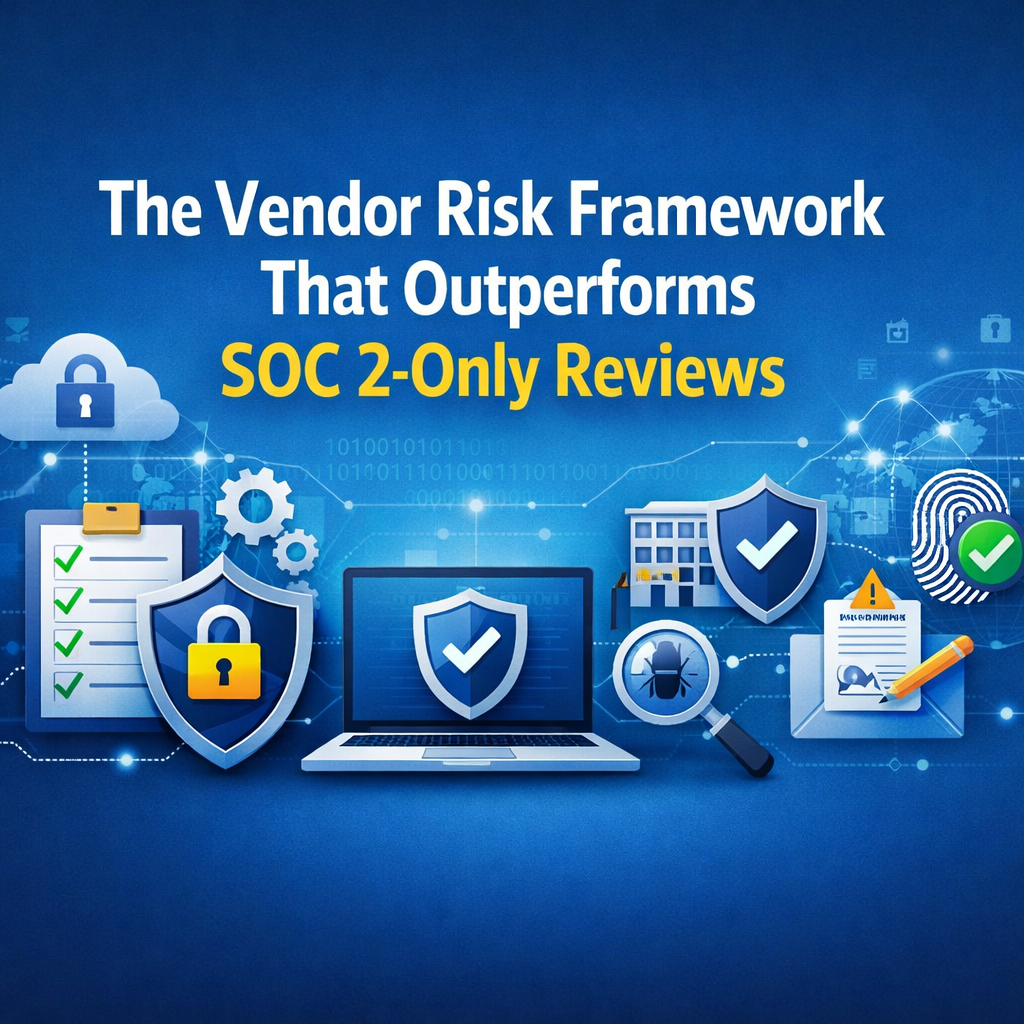
Quick Answer: SOC 2 reports alone are insufficient for vendor risk assessment. Organizations should map vendor controls to their own security frameworks, classify vendors by risk tier, operationalize complementary user entity controls (CUECs), prepare incident response playbooks for vendor breaches, and continuously monitor AI-related vendor risks. This shift from checkbox compliance to risk-based vendor management protects member data and reduces operational risk.
Vendor risk management is no longer a back-office compliance activity. High-profile breaches are frequently traced to third-party vulnerabilities, and regulators have intensified scrutiny. A single vendor compromise can cascade into regulatory penalties, reputational damage, and business disruption.
Yet many organizations still treat vendor management as a checkbox exercise—collecting a SOC 2 report and moving on—rather than as an ongoing, risk-based discipline.
AI-Powered Vendor Security Reviews

The Common Mistake: Organizations collect a SOC 2 report, see no exceptions noted, check the box, and
assume due diligence is complete.
Why This Fails:
Scope Limitations: SOC 2 reports cover only certain systems, functions, or geographies—often excluding the exact systems your organization depends on.
Real Example: One vendor outsourced software development, maintenance, and hosting. Their SOC 2 audit covered only basic admin functions like finance—nothing about the actual application. A reviewer who saw "no exceptions" would miss that the audit didn't cover the critical system at all.
Type Differences: SOC 1 and SOC 2 Type 1 are weaker than SOC 2 Type 2 (which covers a reporting period). Understanding which you have matters.
Point-in-Time Snapshot: SOC reports are a snapshot at one moment—they don't reflect ongoing control effectiveness or changes made after the audit.
Vendor-Auditor Dynamics: Vendors hire and pay auditors, creating potential conflicts of interest. While auditors do honest work, their findings may be limited by these dynamics.
Your Action Items:
Key Takeaway: Seeing "no exceptions" in a SOC report does not equal "no risk." This is checkbox compliance, and it's very risky.
Instead of relying on SOC reports alone, benchmark vendor controls against your organization's own security framework.
Step 1: Choose Your Control Framework
Why It Works: You're not trying to decode a 200-page SOC report against an unknown standard. You're comparing what you know and care about against what the vendor actually does.
Step 2: Request Vendor Documentation
Step 3: Map Controls to Your Framework
Step 4: Gap Analysis
Step 5: Engage Business Stakeholders
Step 6: Document & Automate
Why It Works: This approach proves you're managing risk, not collecting paperwork. Auditors and regulators recognize genuine due diligence.
The Question: How frequently should vendors be assessed?
The Answer: It depends on risk and criticality.
Tier |
Characteristics | Review Frequency | Examples |
|---|---|---|---|
Tier 1 (Critical) |
Stores/transmits sensitive data; essential for operations | Annual minimum | Payment processors, core banking systems, cloud infrastructure, disaster recovery |
Tier 2 (High) |
Access to sensitive data; important to operations | Annual to biennial | Fintech integrations, credit reporting agencies, backup vendors |
Tier 3 (Standard) |
Limited data access; non-critical functions | Biennial to triennial | Software utilities, general business services |
Tier 4 (Low) |
No sensitive data; easily replaceable | Triennial or as-needed | Office supplies, non-critical tools |
Regardless of normal review cycle, immediately reassess vendors when:
Your Action Items:
Key Insight: Classification-based frequency is dramatically more efficient than reviewing all vendors equally. Focus effort where risk is highest.
What Are CUECs?
Complementary User Entity Controls are requirements that your organization must implement for the vendor's controls to function as promised.
Storage Unit Analogy: The vendor (storage facility) secures the perimeter with fences, cameras, and gate locks. But if you don't put a lock on your own unit, anyone inside the fence can access your belongings. Your lock is the complementary control.
Cybersecurity Example: Vendor offers multi-factor authentication (MFA) in their system. But MFA only works if your organization enables it, provisions users correctly, and enforces enrollment. If you skip this, MFA might be listed in the SOC report with "no exceptions," but you're not actually protected.
Vendor Control |
Your Required CUEC |
|---|---|
Vendor offers MFA |
You must enable MFA for all users |
Vendor provides encryption |
You must configure encryption correctly |
Vendor logs access |
You must monitor and review logs |
Vendor requires strong passwords |
You must enforce password policies |
Vendor provides role-based access controls |
You must assign and manage roles |
Mistake #1: Ignoring Them – Many organizations skip the CUECs section of SOC reports entirely.
Mistake #2: Assuming Vendor Responsibility – CUECs are explicitly for your organization, not the vendor.
Mistake #3: Not Operationalizing Them – CUECs are often forgotten after initial onboarding and never tested.
Your Action Items:
Key Insight: If a breach occurs and you haven't implemented required CUECs, you're partially at fault—regardless of what the SOC report says. You can't outsource your responsibility.
The Scenario: A critical vendor refuses to share complete security documentation or won't provide a SOC report.
Option 1: Risk Avoidance (Best)
Option 2: Risk Exception Process (If Vendor Is Critical)
Option 3: Alternative Validation
Your Action Items:
Key Insight: The earlier you enforce security requirements (RFP stage), the better your leverage. Once a vendor is selected after months of evaluation, you have little bargaining power.
No matter how strong vendor controls are, a vendor breach will eventually occur. Preparation is critical.
Key Components:
Contract Requirements:
Your Action Items:
Key Insight: Once you've developed a vendor breach playbook, use it in tabletop exercises. Test it with the
actual team members who would respond. Real incident response is muscle memory—test it often.
AI is transforming vendor landscapes and introducing new categories of risk that traditional SOC reports don't address.
New AI-Related Risks:
Risk Category |
What to Assess |
|---|---|
Data Poisoning |
Is training data secure? Can attackers inject malicious data? |
Model Bias |
Are vendor AI models tested for bias? Can bias cause compliance violations? |
Operational Drift |
Does vendor monitor model performance over time? Can models degrade without notice? |
Regulatory Risk |
Does vendor's AI comply with emerging AI regulations (EU AI Act, state laws)? |
Privacy Leakage |
Does vendor's AI training use customer data? Are privacy controls adequate? |
A point-in-time vendor assessment (once per year) cannot capture the dynamic nature of AI systems. Models change, training data evolves, and performance drifts over time.
Your Action Items:
Key Insight: With AI vendors, continuous monitoring (not annual reviews) is the baseline. AI systems change constantly, and point-in-time assessments are obsolete before the ink dries.
Real vendor risk maturity requires shifting from collecting artifacts to genuinely managing risk.
What Mature VRM Looks Like:
1. Integrate Into Risk Program
2. Prioritize
3. Quantify Decisions
4. Automate Where Appropriate
Vendor risk management is far more than paperwork collection. By shifting from reactive compliance to thoughtful, risk-based, continuous engagement, you not only protect your organization—you transform vendor management from a bottleneck into a strategic advantage.
The institutions winning at vendor management today aren't smarter or better-funded. They're simply more intentional about treating vendor risk as a core business function, not an annual checkbox.
AI-Powered Vendor Security Reviews

1 min read
Lucas Hathaway : 29 Apr 2026
For CISOs, risk leaders, compliance teams, and internal audit stakeholders at financial institutions, an AI inventory is quickly becoming a practical...
1 min read
Lucas Hathaway : 01 Jul 2026
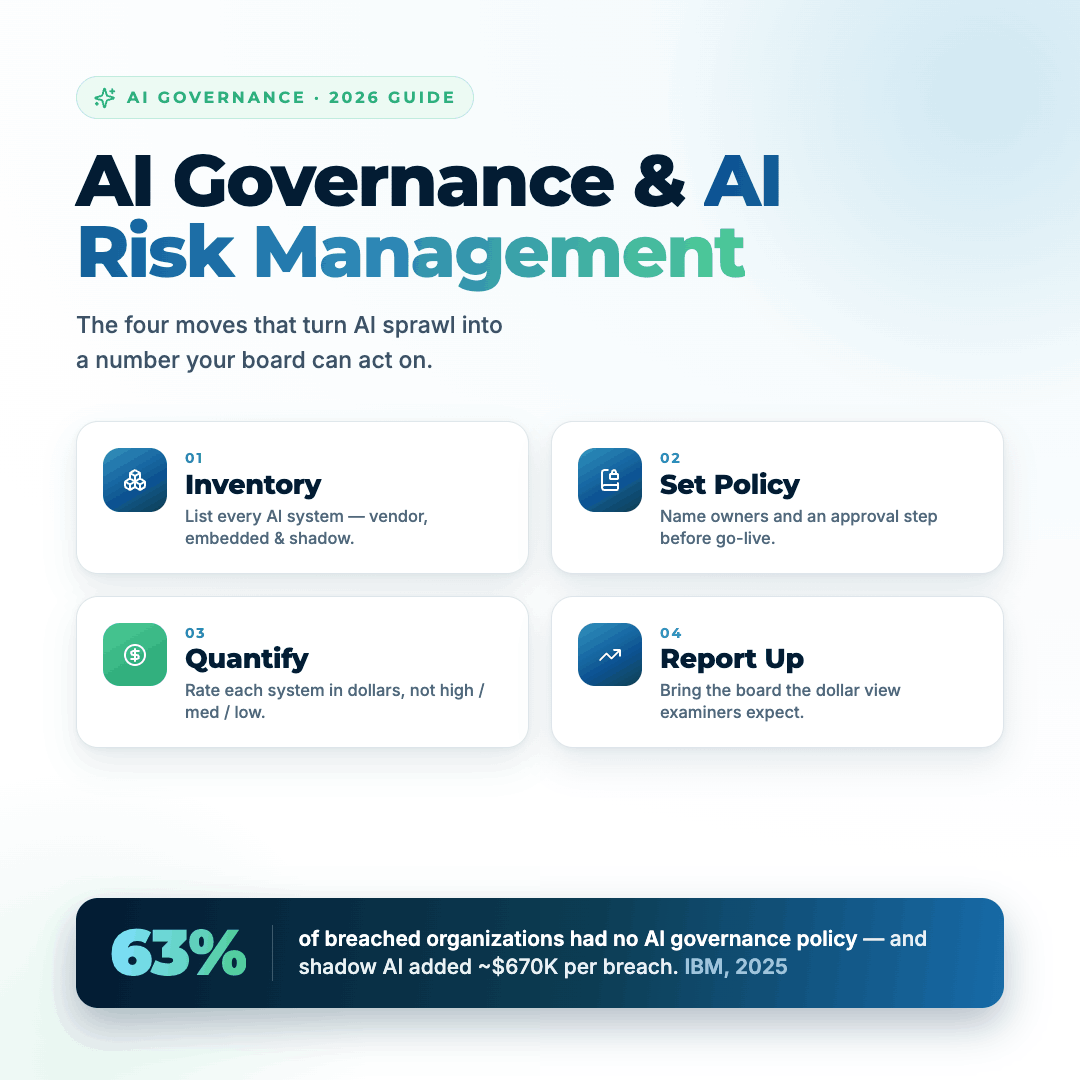
Quick answer: AI governance is the set of policies, owners, and controls that decide how your organization adopts and runs AI. AI risk management is...
1 min read
Lucas Hathaway : 14 May 2025
Here are the key takeaways from this blog: Vendor trust isn't security—verify everything. Embed cybersecurity requirements into contracts, conduct...