Quick answer: AI governance is the set of policies, owners, and controls that decide how your organization adopts and runs AI. AI risk management is the ongoing work of finding, rating, and reducing the risks those AI systems create. You need both. Governance sets the rules, risk management keeps them honest as your AI footprint grows. The fastest place to start is a written AI inventory and a policy that names who owns each system. The next step is to put a dollar figure on what each AI use case could cost you if it fails.
If you lead security at a credit union, bank, or other regulated organization, you have probably watched AI show up faster than anyone planned for. It is in vendor tools you already pay for, embedded features turned on by default, and quiet shadow use across teams. Examiners have noticed too. The pressure is no longer "do you use AI," it is "show us how you govern it."
This guide breaks down what AI governance and AI risk management actually require, how they differ, the controls regulators are asking for, the mistakes that sink most programs, and how to translate AI risk into a number your board can act on.
More AI Governance Resources
Built for lean security teams in highly regulated industries


What is the difference between AI governance and AI risk management?
The two terms get used interchangeably, and that is part of the problem. They are related but they are not the same job.
AI governance is the rulebook. It defines what AI your organization is allowed to use, who can approve it, where it gets recorded, what data it may touch, and how often it is reviewed. Governance is mostly a set of decisions and a structure that holds them.
AI risk management is the ongoing practice. It takes the systems your governance has cataloged and asks, for each one, what could go wrong, how likely is it, and how much would it cost. Then it does something about the ones that matter.
A simple way to hold the distinction: governance tells you what you have and who owns it, risk management tells you which of those things could actually hurt you and by how much. Skip governance and risk management has nothing to work from. Skip risk management and governance becomes a binder no one acts on.
What does AI governance look like in practice?
Governance is not a committee or a slide deck. It is a small set of decisions you make once and enforce every time:
Who can approve a new AI use case before it goes live. Where every AI system is recorded. What data each system is allowed to touch. Who owns the system on the business side and the technical side. How often you review it.
The NIST AI Risk Management Framework organizes this around four functions: Govern, Map, Measure, and Manage. Govern 1.6 is the one most teams fail first. It calls for a documented, resourced inventory of AI systems tied to your risk priorities. In plain terms: you cannot govern AI you cannot see, and most organizations still cannot see all of theirs. For a deeper walkthrough of the framework, see our practical guide to the NIST AI Risk Management Framework.
Start with the inventory. A centralized list that captures every AI use case, its owner, the data it touches, and a preliminary risk rating is the foundation everything else sits on. If you are building one from scratch, our AI governance framework guide covers the policy and roles that wrap around it.
What does AI risk management add?
Governance tells you what you have and who owns it. Risk management tells you which of those things could actually hurt you, and by how much.
The risks worth rating are concrete. A vendor model that processes member data. An embedded feature that makes lending or fraud decisions. A staff tool that quietly sends sensitive data to a public AI service. Each one carries a different mix of data exposure, regulatory exposure, and operational risk, and each deserves a different level of attention.
Walk through one example. Say your collections team starts using a public generative AI tool to draft member letters, and they paste real account details into it to save time. That single habit creates a data exposure risk (sensitive data leaving your control), a regulatory risk (member data handled outside your policies), and a vendor risk (a third party you never assessed now holds your data). Governance would have caught it at the approval step. Risk management is what tells you, once you find it, how urgent it is compared to everything else on your plate.
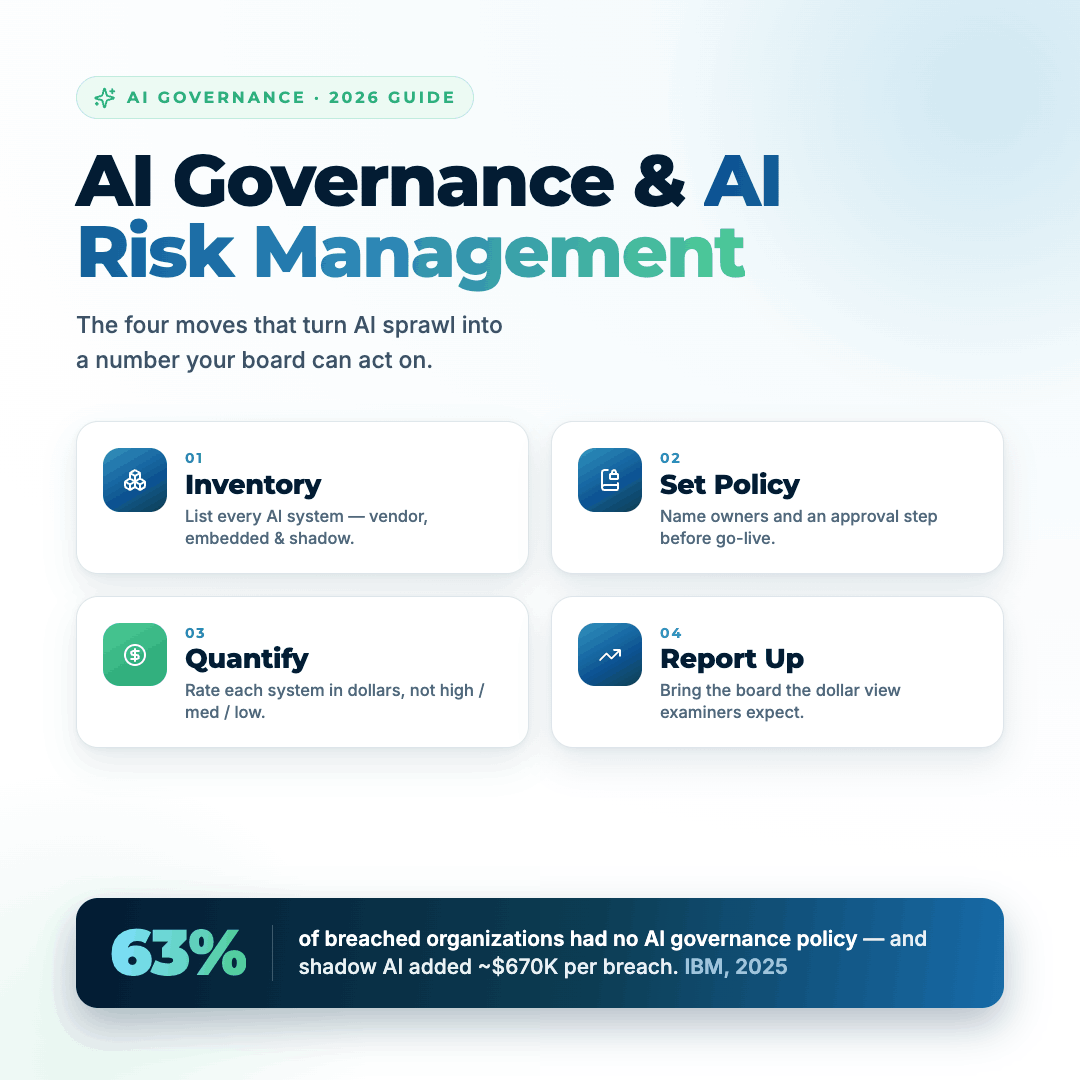
The numbers from the past year make the case better than any warning. IBM's 2025 Cost of a Data Breach Report found that 63% of breached organizations had no AI governance policies at all, and that breaches involving unsanctioned "shadow" AI cost about $670,000 more than the average breach. Among organizations that suffered an AI-related breach, 97% lacked proper access controls on those systems. The gap between how fast AI is being adopted and how slowly it is being governed is exactly where the loss is showing up.
What are the biggest AI risks to manage?
Most AI risk falls into a handful of buckets. Knowing them makes your inventory and ratings faster.
Data leakage is the one people picture first: sensitive data flowing into an AI system that was never cleared to hold it, often a public tool. Third-party and vendor risk is close behind, because much of your AI now arrives inside software you bought rather than software you built, and a third party was involved in 30% of breaches in Verizon's 2025 report. Then there is decision risk, where an AI system makes or influences a consequential call (lending, fraud, hiring) and gets it wrong at scale. Model and access risk covers who can reach a model and what it is allowed to do. And shadow AI cuts across all of these: the use you do not know about, which by definition you cannot govern.
You do not have to solve all of these at once. You have to see them, rate them, and work the biggest ones first.
Put AI risk in dollars, not high, medium, low
Here is the move that changes the conversation. A risk register that rates your AI systems "high, medium, low" tells your board almost nothing. High compared to what? Worth spending what to fix?
Instead, express each AI risk as a dollar figure: the likely financial impact if that system fails, leaks, or makes a bad decision at scale. A shadow AI tool that could expose member data is not just "high risk," it is a defined range of potential loss you can weigh against the cost of controlling it. That framing is what lets a board approve spending and an examiner see that you understand your own exposure.
This is the core of how Rivial approaches AI risk. You tag each AI system during an assessment, and the platform models the financial impact using an eight-element Cyber Risk Model and Monte Carlo simulation, so the output is a dollar range you can report to the board rather than a color. The same assessment that satisfies the examiner produces the number that wins budget. You can see the early shape of that work on our AI risk management solution and run a quick estimate with the AI risk calculator. If you want the underlying method, our guide to cyber risk quantification models explains how the dollar figure is built.
A practical order of operations
You do not need a year and a consultant to start. Work in this order:
- Build the inventory. List every AI use case you know of, starting with vendor and embedded tools, then shadow use.
- Write the policy. Name owners, set an approval step before any new AI goes live, and define your review cadence.
- Rate each system. Score data sensitivity, decision impact, and oversight, then translate the worst cases into dollars.
- Close the obvious gaps. Access controls and monitoring on the systems touching sensitive data come first.
- Report up. Bring the board the dollar-denominated view, not the color-coded one.
Each pass gets faster. The first version of your inventory and policy can exist this week, and you tighten both as your AI footprint grows.
What mistakes sink most AI programs?
Three patterns show up again and again.
The first is governing in a vacuum: writing a long policy before anyone has listed the AI actually in use, so the rules never match reality. Build the inventory first.
The second is stopping at a color. Teams run a rating exercise, land on a register full of "high" and "medium," and have no basis to prioritize spend. Quantify the ones that matter.
The third is treating it as a one-time project. AI changes monthly, with new vendor features and new staff habits. A framework that is not reviewed on a cadence quietly goes stale, and the next exam finds the gap before you do.
Frequently asked questions
Is AI governance required by regulation? In most cases it is not yet a hard legal mandate for every organization, but examiners in financial services and other regulated sectors are actively asking how you govern AI, and frameworks like the NIST AI RMF are the reference they point to. Treat it as expected, not optional.
Where should a lean team start? With the inventory and a short policy. You cannot govern or rate AI you have not listed, and a one-tab inventory plus a two-page policy beats a perfect program that never ships.
What is shadow AI? Shadow AI is any AI use that happens outside your governance: staff using public tools, or vendor features turned on without review. It is the riskiest category precisely because you do not know it is there. IBM tied shadow AI to roughly $670,000 in added breach cost in 2025.
How is AI risk different from regular cyber risk? The core method is the same: find it, rate it, reduce it, report it in dollars. What is different is the sources (models, training data, vendor features, autonomous decisions) and how fast the footprint changes. The framework is familiar, the inventory is the new work.
How often should we review our AI inventory and risk ratings? Quarterly is a reasonable default for most lean teams, with a requirement to register any new AI before it goes live. Higher-risk systems that touch sensitive data or make decisions deserve more frequent review.
Get the AI Risk Management whitepaper
We pulled the full approach into one place: how to inventory AI, map it to NIST AI RMF, rate it, and report it in financial terms. Download the AI Risk Management whitepaper. It is an instant download, no sales call required.
Here are the key takeaways from this blog:
- Governance and risk management are two halves of one job: governance sets the rules and owners, risk management keeps rating and reducing the exposure as AI spreads.
- Start with the inventory: NIST AI RMF Govern 1.6 expects a documented, resourced list of every AI system, and most organizations do not have one.
- The losses are real and measured: 63% of breached organizations had no AI governance policy, and shadow AI added about $670,000 per breach in 2025.
- Quantify in dollars: a financial impact range beats a high, medium, low rating for both the board and the examiner.
- Avoid the three traps: do not govern in a vacuum, do not stop at a color, and do not treat it as a one-time project.
More AI Governance Resources
Built for lean security teams in highly regulated industries


 Lucas Hathaway
 Lucas Hathaway : 01 Apr 2026