
 Lucas Hathaway
On our September AI governance webinar, one question came up more than any other, in several different forms: do we write one AI policy or two? Does AI governance belong in its own document, or inside the information security policy we already have? And where does the acceptable use policy fit?
If you are asking the same thing, you are in good company. We have run about 40 AI governance assessments this year, and policy structure is the first decision almost every institution gets stuck on. Here is the structure we recommend, and the reasoning, so you can make the call in one meeting instead of five.
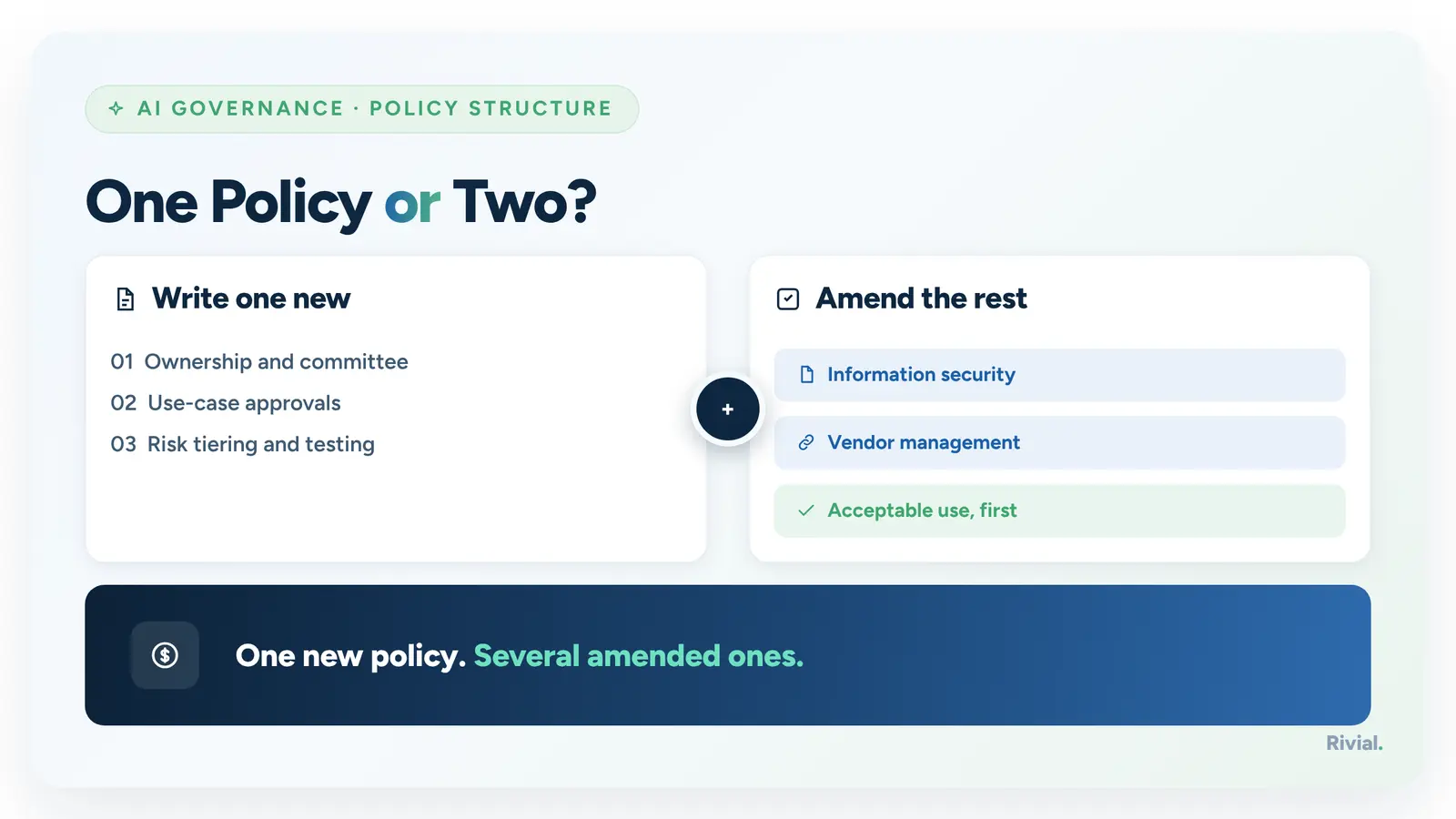
Quick answer: Write one new standalone AI governance policy, the document that answers who decides, covering ownership, use-case approvals, inventory, risk tiering, reviews by tier, model testing, and vendor management. Then amend the policies you already have (information security, data governance, vendor management, incident response) with AI sections that reference it. Update the acceptable use policy early if employees are already using AI, which they are. One new policy, several amended ones. The structure has to satisfy the examiner's document list and the board's one question: which AI systems put us past our risk tolerance, and why did we accept them.
AI Information Security Policy Template
Covers the NIST core areas so you are editing, not authoring


The short answer
Write a standalone AI governance policy first. Then expand the policies you already have (information security, data governance, vendor management, incident response) with AI sections that reference it. Add or update the acceptable use policy early if your employees are already using AI, which, from what we see in assessments, they are.
So the honest answer to "one policy or two" is: one new policy, several amended ones. What you want to avoid is the two failure modes we find in policy reviews. The first is stuffing all of AI into the existing information security policy, where governance questions like who approves a new use case have no natural home and never get answered. The second is writing five new AI documents at once, which guarantees none of them get through the board this year.
What goes in the AI governance policy
The governance policy is the document that answers "who decides." When we review AI policies, the most common finding is that the NIST core areas are simply missing, and an examiner who does not see them assumes they are not happening. Make sure these seven are in the document:
- Ownership. Who owns AI governance, by role, and which committee it reports through.
- Decision making. How a new AI use case gets proposed, reviewed, and approved or rejected.
- Inventory. The commitment to keep a current inventory of AI systems and AI features inside vendor products.
- Risk tiering. How use cases get sorted by risk, and what drives the tier (customer data and decision-making are the two questions that matter most).
- Reviews by tier. What level of review each tier gets, so a research tool is not reviewed like a lending model.
- Model testing. How systems that make or influence decisions get tested, and how often.
- Vendor management. How AI due diligence plugs into your existing vendor program.
One more structural idea worth stealing came from an attendee on the September session: a board-approved policy that sets the principles, paired with a management-level playbook that holds the detail and can change without going back to the board. We endorsed it on the spot. It is the same reason institutions keep policies and standards separate, and it answers the pace-of-change worry that makes committees avoid writing anything down.
What changes in the policies you already have
The governance policy does not replace your existing documents. It gives them something to point at. The information security policy gets an AI section covering security controls for AI systems and references the governance policy for approvals. Data governance gets expanded to cover data flowing into and out of AI, a question an attendee asked directly in September, and the answer is to extend the policy you have, not write a competing one. Vendor management picks up the AI due diligence questions and contract items. Incident response gets AI scenarios, because a model being confidently wrong is an incident even when nothing is breached.
For banks with a model risk management program, the related question is whether AI governance and MRM should merge into one framework. We lean toward keeping them separate unless the same people and processes genuinely cover both. Merging them on paper when they are split in practice just creates a policy nobody follows.
And the acceptable use policy deserves its own mention, because it is the most urgent document in the stack if employees are already using AI tools. Our guide to building an AI acceptable use policy covers it start to finish. A practical note from the September Q&A: once the AUP exists, train people on your own AUP rather than a generic vendor module. It is shorter, it is relevant, and it is the training examiners actually ask about.
The test your structure has to pass
Whatever structure you land on, it has to survive two audiences. The examiner will ask to see the policy, the acceptable use update, the committee charter, the inventory, and samples of your vendor reviews and AI risk assessments. That list comes straight from what we are seeing requested this year, so let it drive what you write first. The board will ask something simpler: which AI systems put us past our risk tolerance, and why did we accept them? That question only has a good answer in dollars. A system that is $300,000 over a $1 million tolerance can be discussed and accepted on the record; "medium-high" cannot.
This is exactly where Rivial Software earns its keep: AI use cases get risk-assessed inside the same quantified model as the rest of your program, so the governance policy's tiers and the board's dollar figures come from one place instead of two documents that disagree. For the full picture of how the pieces fit, see our AI governance and AI risk management guide.
The key is to treat the policy as the start of a loop, not a deliverable. Policy sets the rules, the inventory feeds the risk assessments, the assessments feed the board report, and the board report proves the policy is alive. That loop is what a smooth AI exam looks like.
Start from a template, not a blank page
If you are writing the first document now, our free AI Information Security Policy template covers the NIST core areas above so you are editing instead of authoring. Instant download, no sales call required.
Here are the key takeaways from this blog:
- One new policy, several amended ones: write a standalone AI governance policy, then add referencing AI sections to the infosec, data governance, vendor, and IR policies you already have.
- Cover the seven core areas: ownership, decision making, inventory, risk tiering, reviews by tier, model testing, and vendor management; examiners assume a missing area is not happening.
- Policy plus playbook: let the board approve principles and keep the fast-changing detail in a management playbook, so governance keeps pace with the tools.
- Prove it in dollars: the board's real question is which AI systems exceed tolerance and why you accepted them, and only a quantified answer holds up.
Write the First Document This Week
Start from the template, or walk through your policy structure with our team